
Need a High-Performance Fastener Alternative? Send Us Your Specs
Need a High-Performance Fastener Alternative? Send Us Your Specs
Case Study
Ball Bearing Retention in Aluminum Housings
A correctly-sized interference fit destroyed a ball bearing assembly when operating temperature exposed a fundamental material mismatch. Here’s what failed, why it failed, and how a tolerance ring fixed it.
Root Cause Analysis
The CHALLENGE with Interference Fits at Temperature
Housings made of aluminum, magnesium, and even plastics are often used in rotating machinery like electric motors, EV drives, pumps, fans and compressors. In these scenarios, engineers commonly mount steel ball bearings using a standard interference fit. The fit is calculated at room temperature and typically held within spec during initial assembly. The problem appears in service.
Retaining a ball bearing becomes difficult when wide service temperature ranges are encountered, especially with aluminum housings. Because the housing material has a different coefficient of thermal expansion than the ball bearing, a press fit that is correctly sized at room temperature loosens at higher temperatures. The problem is further exacerbated when the ball bearing diameter increases.
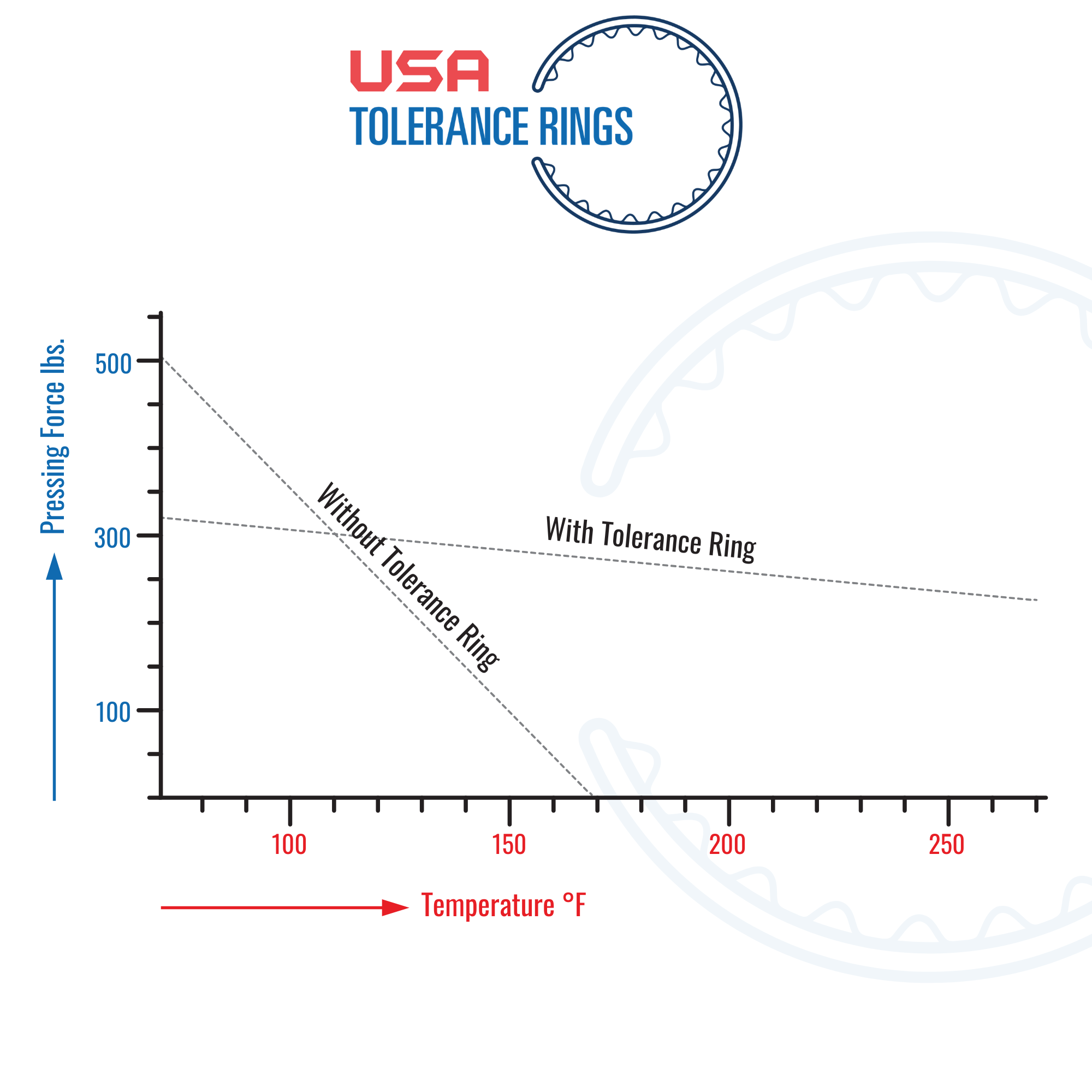
For instance: A ≈2 inch OD steel ball bearing (e.g., 6205) press-fitted into an aluminum housing with a 0.0012″ interference fit required 500 lbs of installation force at room temperature. Due to thermal growth between the steel bearing and aluminum housing, the bearing became loose at 170°F. This resulted in outer race slippage, followed by eventual destruction of the ball bearing and component surfaces.
The Solution
How Tolerance Rings HOLD THROUGH EXTREME TEMPERATURE
A tolerance ring was installed between the bearing outer race and housing bore to hold the bearing via a different mechanism. Instead of relying on a dimensional interference that is dependent on temperature, the ring’s corrugated spring steel waves exert a continuous radial clamping force that accommodates dimensional change as the assembly heats and cools.
The ring was sized to maintain compression across the full operating temperature range, so retention force remained consistent rather than disappearing at the threshold where the housing expanded past the bearing.
Results
What the Data Showed
Engineering Explanation
WHY THE TOLERANCE RING SUCCEEDED WHERE THE PRESS FIT FAILED
The tolerance ring’s spring rate was lower than the housing stiffness, so it absorbed the differential expansion between housing and bearing race rather than transmitting it as a loss of retention. The corrugated waves remained in compression across the temperature range, and the axial retention force (a function of the radial clamping load and coefficient of friction) scaled predictably with ring geometry.
| Application Type | Ball bearing mount in aluminum housing |
| Bearing | 6205 series, ~2.00″ OD |
| Housing Material | Aluminum |
| Ring Style | AN style (waves inward, securing outer race to housing bore) |
| Key Materials | 301 stainless steel (stable to 450°F) or hardened carbon steel (stable to 250°F) |
| Industry | Electric motors, EV drives, pumps, fans, any aluminum-housed rotating assembly |
ENGINEERING EXPLANATION
Industries