Fastener Solutions

Fastener Solutions

Bearing Mount

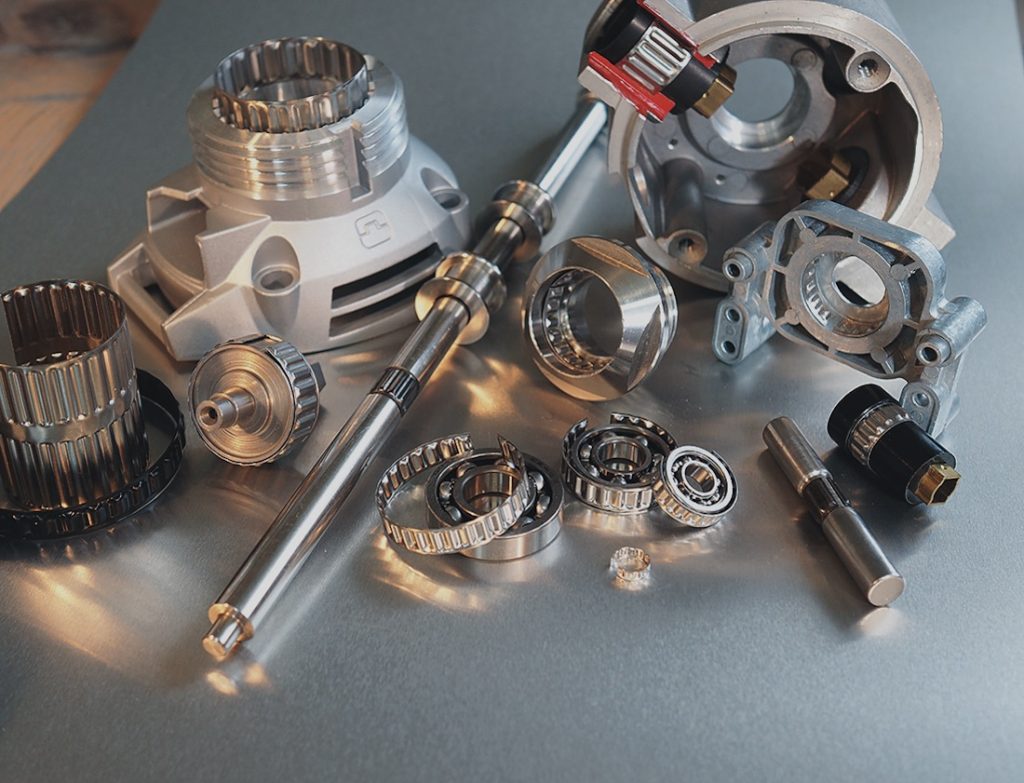
Tolerance rings can prevent the loss of retention experienced when mounting steel bearings to a housing with a different rate of thermal expansion.

Bushings and Sleeves

A tolerance ring’s unique wave properties provide a secure grip for holding bushings (i.e., bronze, plastic) and sleeves both firmly and gently in place. Torque and axial retention requirements are met while cushioning them from thermally induced stresses from adjacent components.

Torque Transfer

Tolerance rings can be used to transmit torque from one cylindrical component to another, without the need for costly splines or expensive keyways. Gears, pulleys, disks, sprockets, flywheels, rollers, impellers are a sample of the many torque transmitting components that can be mounted with tolerance rings. Unlike a keyway’s tolerances which result in backlash with a change in rotational direction, the tolerance ring provides zero backlash.

Slip Clutch

A tolerance ring can act as a mechanical ‘circuit-breaker’, triggering a slip at an overload point.  This protects the mechanical components from damage, and will reduce the number of parts needed in an assembly.

Stator Mount

Using a tolerance ring in a stator mount will secure the stator through thermal ranges and provide torque resistance in a cost-effective assembly solution.

Fastening/Joining

Tolerance rings are well suited for fastening and joining different or dissimilar materials. To allow for future repair or removal, they provide an alternative when a permanent bond is not desired. Faster assembly can be achieved without the use or curing time of messy adhesives.


Fastener Solutions That Build It Better

Flexible design. Reliable performance. Made in the USA.

USA Tolerance Rings empowers engineers with innovative fastener solutions that address real-world engineering challenges.

Whether you’re designing for ball bearing assemblies, extreme environments, or high-precision manufacturing, our tolerance rings offer a proven alternative to adhesives, press fits, and traditional fasteners.

See how our tolerance rings are enhancing performance across applications, helping engineers overcome mechanical design limitations so you can build smarter, faster, and more reliably.

What Can a Tolerance Ring Do for You?

Control Thermal Expansion

Compensate for material shifts due to temperature fluctuations, without relying on adhesives or tight press fits.

Improve Radial Alignment

Maintain concentricity between components and reduce alignment issues, even with less precise machining tolerances.

Provide Torque Overload Protection

Protect components from damage by allowing controlled slippage when torque exceeds critical thresholds.

Reduce Vibration and Noise

Eliminate rattle, hum, and shake. Designs using tolerance rings remain aligned, which reduces the opportunity for vibration and maintains a tighter fit.

Simplify Manufacturing

Reduce secondary operations and loosen machining tolerances while still achieving secure, consistent assembly.

Easy Replacement and Improve Serviceability

Enable assembly and disassembly that’s fast and repeatable even in field service environments—no specialized tools required.

Engineered for Performance in the USA

We don’t just manufacture parts. We partner with you to engineer better designs.

With 2000+ tolerance ring sizes, custom solutions, and a team of expert engineers ready to collaborate, we help you solve the toughest challenges in your application.

Ready to Get Started?

Start a New Project     Download Our Catalog

REPAIR WORN OR OVERSIZED HOUSING BORES

Tolerance rings can be used to reclaim worn housing bores or bearing pockets which have been accidentally machined oversized. By adjusting the inside diameter with additional machining to accommodate the Tolerance Ring, the original intended (or alternate) ball bearing size can be installed. AN-style rings for popular ball bearing sizes are packaged individually and sold as TR packs in the aftermarket.

GLASS-FILLED MOLDED PLASTIC HOUSINGS

The ring’s waves expand and contract to accommodate thermal expansion of the housing. Glass is needed as a hardener to prevent the ring from wallowing its way (creeping) into the housing. Typically, there is no need for an insert ring or any secondary machining operations.

ZINC-DIECAST BEARING BRACKETS

Since draft angle on these brackets is minimal, they normally require no secondary machining opera- tion. Oftentimes ANL or light duty AN-style rings are used to keep assembly forces low to avoid barrelling the bearing during assembly. Whereas glue and rubber boots trap heat, airflow around the rings may allow the bearing to run cooler.

TORQUE TRANSFER

Tolerance rings often mount ball bearing outer races to retain the bearing in thermal growth applications. Similarly, the rings can be used in high temperature applications involving dissimilar materials such as steel shafts to plastic glass filled fan hubs or impellers.

HANDLES & KNOBS

Quickly assembling a handle or knob onto a shaft reduces production time and labor costs. Using epoxy or adhesives can be messy and doesn’t allow for future replacement. A tolerance ring rapidly attaches handles or knobs onto shafts and still allows for future repair or replacement.

Bushings and Sleeves

A tolerance ring’s unique wave properties provide a secure grip for holding bushings (i.e., bronze, plastic) and sleeves both firmly and gently in place. Torque and axial retention requirements are met while cushioning them from thermally induced stresses from adjacent components.

Related Post

Fastener Solutions

Bearing Mount Tolerance rings can prevent the loss of retention experienced when mounting steel bearings to a housing with a different rate of thermal expansion.

Read More »