
Need a High-Performance Fastener Alternative? Send Us Your Specs
Need a High-Performance Fastener Alternative? Send Us Your Specs
Case Study
ABS Motor Bearing Solution
How USA Tolerance Rings solved bearing retention in Siemens’ stamped steel ABS and cooling fan motor housings, without adding a secondary bore machining operation.
Root Cause Analysis
The CHALLENGE with Interference Fits at Temperature
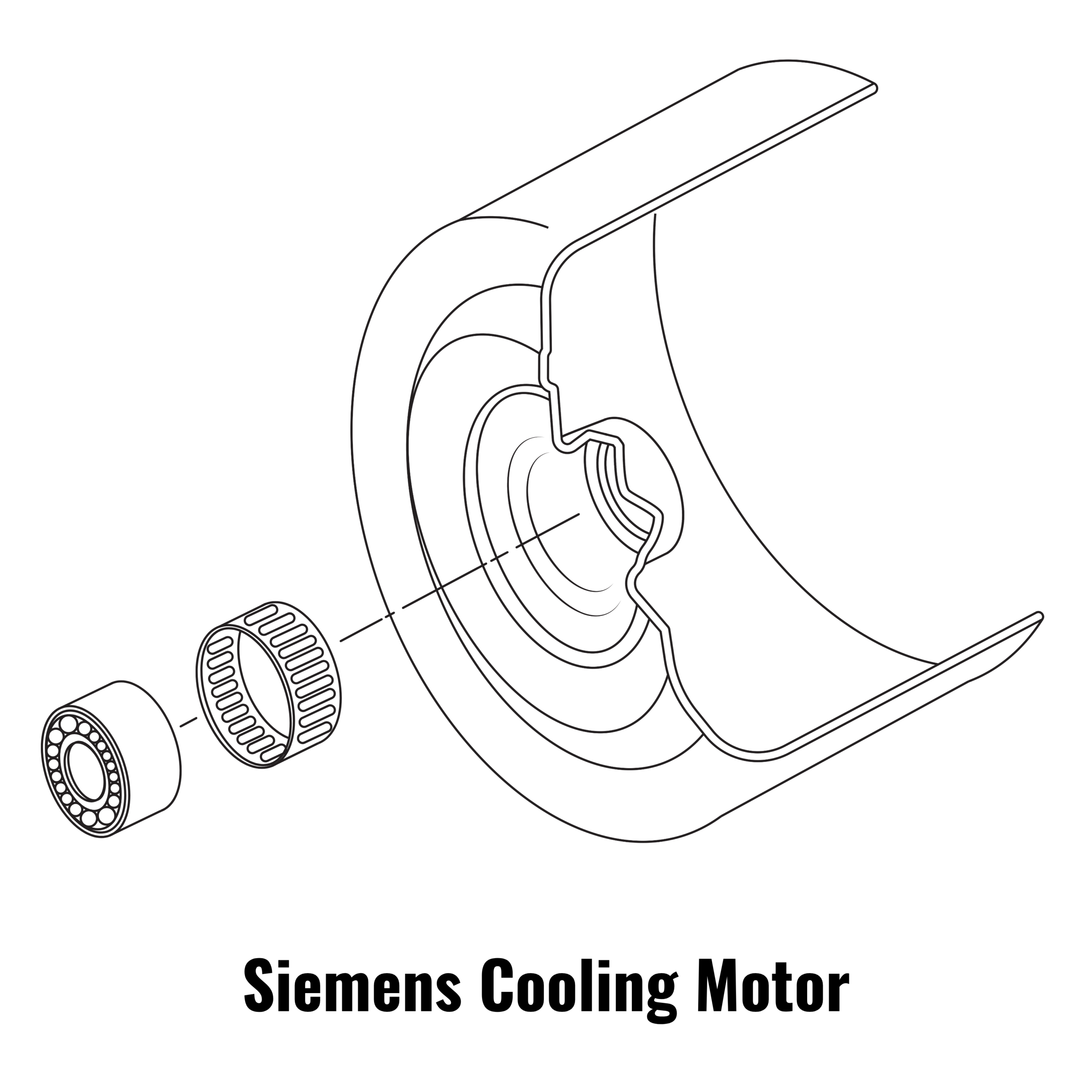
Siemens’ facility in London, Ontario manufactured ABS and engine cooling fan motors supplied to the automotive market in North America and Europe. The motor housing, which mounted a 608 ball bearing and supported the motor armature, was formed from a single steel component using a progressive stamping operation.
Progressive stamping was efficient and repeatable, but it introduced a fundamental challenge for precision component retention: The dimensional variation inherent in stamped steel housings was wider than what a standard bearing press fit could tolerate.
A standard press fit for a precision ball bearing required the housing bore to be held to within a few ten-thousandths of an inch. Stamped steel housings could not consistently achieve this tolerance as stamping was not a precision-bore process. To use a press fit, Siemens would have needed to machine the bore after stamping, adding a secondary operation and cost to a high-volume production line.
The bearing had to be held both radially and axially to mount the armature correctly. The retention solution had to work within the as-stamped housing dimensions, hold consistently across the full manufacturing tolerance range, and not introduce so much radial stiffness that it compromised the bearing’s internal clearance at the minimum bore dimension.
The Solution
How Tolerance Rings HOLD THROUGH EXTREME TEMPERATURE
USA Tolerance Rings designed a ring for the Siemens blower motor application that provided consistent and predictable radial force across the stamped housing tolerance range. The ring’s corrugations absorbed the bore dimensional variation, eliminating the need for post-stamp bore finishing.
The ring geometry was specified so that the radial force at maximum bore clearance remained sufficient for retention, while the force at minimum bore dimension did not compress the ring stiffly enough to reduce the bearing’s internal clearance—a balance that a fixed interference fit could not achieve across a wide tolerance band. Assembly of the ring onto the Siemens line was automated.
Results
What the Data Showed
Engineering Explanation
WHY THE TOLERANCE RING SUCCEEDED WHERE THE PRESS FIT FAILED
The tolerance ring’s spring stiffness was lower than the housing stiffness, so it absorbed bore dimensional variation rather than transmitting it as inconsistent retention force. Because the ring was compressible within its elastic range, the radial force it exerted scaled gradually with bore dimension, providing a self-adjusting fit that a rigid interference could not replicate.
| Customer | Siemens Facility in London, Ontario |
| Application | 608 ball bearing mount in progressively stamped steel motor housing |
| Product | ABS and engine cooling fan motors for automotive market |
| Ring Style | AN style (waves inward, securing outer race to housing bore) |
| Housing Material | Stamped steel, single-component progressive stamp |
| Industry | Automotive electric motors |
ENGINEERING EXPLANATION
Industries