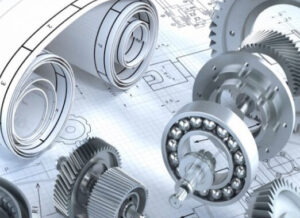
A Smart Way to Save on Precision Manufacturing, Without Compromising Reliability.
In industrial equipment like pumps, conveyors, and compressors, precision is non-negotiable. Bearings, shafts, and housings all have to work together under demanding loads and in variable environments. But achieving that level of precision typically comes with a price tag: extensive machining, tight tolerance requirements, and costly secondary operations add up. Tolerance rings offer another way to help reduce machining costs.
By acting as a compliant interface between components, they allow engineers to loosen machining tolerances without sacrificing performance or reliability. The result can lead to lower production costs, faster assembly, and resilient equipment.
Why Precision Machining Costs So Much
Manufacturers often default to machining housings and shafts to extremely tight dimensional tolerances (bearing tolerances explained). This ensures that press fits or slip fits between bearings and housings remain consistent across thousands of assemblies. But tight machining has drawbacks:
- Higher cost per part due to slower feed rates and additional inspection steps
- Scrap and rework when parts fall out of spec
- Limited supplier base since only certain shops can hold such precision affordably
For large-scale industrial equipment with multiple bearings, gears, and shafts involved, these costs add up quickly.
The Tolerance Ring Alternative
A tolerance ring is a thin, spring-like metal ring with engineered waveforms (corrugations). When placed between a bearing and a housing (or shaft), the tolerance ring compensates for dimensional variation while maintaining consistent retention force.
This means:
- Looser machining tolerances are acceptable: Housings don’t have to be bored to tenths of a thousandth
- There’s no press-fit distortion: Bearings seat securely without risk of brinelling or race damage
- Assembly and disassembly is quick: Ideal for equipment that needs field servicing
The point is, tight press fits can distort or overload the bearing races, while tolerance rings prevent that by providing retention without excessive force. In effect, tolerance rings let the spring do the precision work, not the machine shop.
Application Examples: Pumps, Conveyors, and Compressors
Tolerance rings are not just a theoretical solution. They’re already in use across a wide range of rotating equipment. In industries where uptime, cost control, and durability matter most, engineers are applying tolerance rings to simplify production and improve long-term performance.
Here are three practical examples:
Pumps: Bearings often sit in aluminum or composite housings, which are expensive to machine to tight tolerances. A tolerance ring allows for wider bore dimensions while still holding the steel bearing securely, even under thermal cycling.
Conveyors: Rollers and drive assemblies must balance cost and durability. Tolerance rings reduce the need for precision grinding of shafts, enabling cost-effective, large-volume production.
Compressors: High vibration environments punish rigid press fits. Tolerance rings absorb vibration and prevent fretting wear, all while reducing machining requirements on housings.
Real Cost Savings
Global industry experience supports our findings. For example, UK-based tolerance ring providers report more relaxed machining tolerances and reduced assembly times, especially for pump and conveyor components. German manufacturers highlight that tolerance rings eliminate secondary machining steps. And another European supplier, notes a cost saving of $0.04–$0.06 per unit translating to around $6,000 saved per 100,000 parts.
The Bigger Picture: Precision Where It Matters
Not every surface in a housing or assembly needs to be machined to perfection. Tolerance rings are best applied where they manage fits between rotating or fixed components, such as between a bearing outer race and a housing. By strategically using Tolerance Rings in these interfaces, you can focus machining precision where it truly adds value, like sealing surfaces or critical bearing races, while relaxing tolerances in less critical, non-load-bearing areas.
This balance doesn’t mean tolerance rings are unsuitable elsewhere; it simply highlights where they create the biggest cost and performance advantages. The result is lower production costs and high-performing rotating equipment.
FAQs on Tolerance Rings and Reducing Machining Costs
Q: How do Tolerance Rings reduce machining costs?
A: Tolerance rings allow for looser housing and shaft tolerances while still maintaining secure retention of bearings and components. This reduces the need for costly precision machining. (See Case Study: Pump Housing Machining Cost Reduction, USATR Engineering 2024.)
Q: Will using Tolerance Rings affect equipment reliability?
A: No, using tolerance rings will not affect equipment reliability. In fact, Tolerance Rings often improve reliability by reducing fretting, vibration, and thermal expansion issues common in rigid press fits.
Q: Can Tolerance Rings handle high-vibration environments like compressors?
A: Yes, tolerance rings can withstand high-vibration environments well. Their spring-like structure absorbs vibration and prevents component loosening, extending the life of both bearings and housings.
Q: Are Tolerance Rings only for new equipment designs?
A: Not at all. Tolerance rings are widely used in both OEM production and aftermarket rebuilds, making them a cost-saving option for new builds and retrofits.
Q: What industries benefit most from Tolerance Rings?
A: Any sector with rotating equipment benefits from using tolerance rings. Industries that use pumps, conveyors, and compressors (for instance, HVAC and automotive) can leverage tolerance rings to cut machining costs and improve durability.
Learn More
Want to see how tolerance rings can reduce machining costs in your application? Tell us about your project.