
Need a High-Performance Fastener Alternative? Send Us Your Specs
Need a High-Performance Fastener Alternative? Send Us Your Specs
Case Study
HVAC Packaged Thermal Unit Manufacturer
Press fits trapped a PTU’s bearing inside the casement, where heat and moisture caused early failure. Tolerance rings moved it outside, and made field repair possible.
Root Cause Analysis
The CHALLENGE with Interference Fits at Temperature
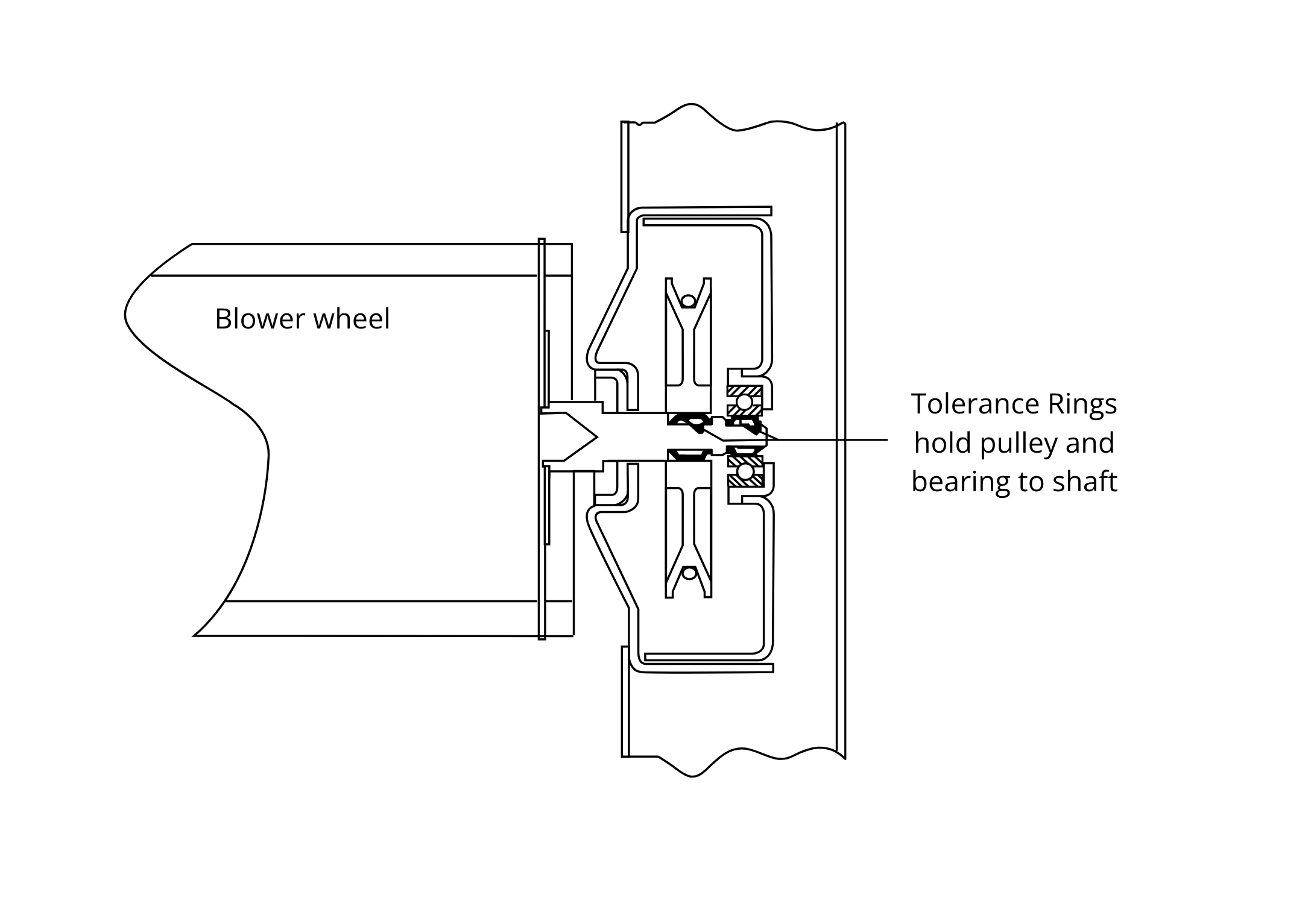
Packaged thermal units (PTUs) are self-contained air conditioners and heat pumps. They often include a blower wheel assembly with a mounted pulley and bearing on a shared shaft. In the original design, the bearing and pulley were mounted using traditional press fits. The assembly was located inside the unit casement.
The operating environment for a PTU was demanding: wide temperature swings between off and operating states, humidity, and limited access to lubricant once assembled. Press fits that were correctly sized at installation could relax under these conditions, causing premature failure.
The high assembly forces required by the original press fits created two problems.
First, the bearing had to be located inside the casement—the only position where the press force could be properly applied and the fit secured during manufacture. Inside the casement, the bearing was exposed to the environmental conditions (temperature cycling, moisture, lubricant starvation) most likely to cause premature failure.
Second, once the bearing failed, field repair required removing and disassembling the unit, dealing with the high disassembly forces of the press-fit components, and reassembling with the same high installation forces. This excessive handling meant repair was time-consuming and technically demanding in the field.
The Solution
How Tolerance Rings HOLD THROUGH EXTREME TEMPERATURE
Two light-duty tolerance rings replaced the press fits for both the pulley and the bearing on the blower wheel shaft. The substantially lower assembly forces required by tolerance rings, compared to press fits, made hand assembly practical.
This changed the architecture of the unit. With hand-assembly retention, the bearing was repositioned outside the casement. Outside the casement, the bearing was no longer exposed to the internal temperature cycling and moisture environment. The bearing failures caused by those environmental conditions were eliminated.
The lower assembly forces also meant the unit could be disassembled and reassembled by a service technician in the field without a press.
Results
What the Data Showed
Engineering Explanation
WHY THE TOLERANCE RING SUCCEEDED WHERE THE PRESS FIT FAILED
Tolerance rings provided retention through spring compression rather than a fixed dimensional interference. Because the clamping force was generated by the ring’s corrugated waves rather than a tight bore-to-shaft fit, assembly and disassembly forces were substantially lower than a press fit sized for the same retention load. This made hand assembly practical and field disassembly reversible.
| Customer | PTU manufacturer |
| Application | Bearing + pulley on blower wheel shaft |
| Ring Type | BN style (waves outward, securing inner race and pulley to shaft) |
| Component Replaced | Traditional press fits for bearing and pulley |
| Housing / Equipment Type | Packaged thermal unit (PTU), self-contained HVAC |
| Industry | HVAC / packaged thermal equipment |
ENGINEERING EXPLANATION
Industries