A bushing is a type of plain bearing. It’s a single-piece sleeve that reduces friction through sliding contact. Rolling-element bearings use balls or rollers for high-speed precision, while bushings generally handle low-speed, high-load, or contaminated duty. But choosing the right component is only half the job. Tolerance rings can mount and retain either one while compensating for tolerance stack-up and thermal expansion.
That last part tends to get skipped. Most technical comparisons stop at component selection and leave the mounting question for someone else to figure out later. In practice, that’s where a lot of rotating assemblies run into trouble.
What Is a Bushing?
A bushing is a plain bearing: a single-piece sleeve, typically metal, polymer, or a composite liner, that supports a rotating or sliding shaft through direct surface contact rather than rolling elements.
That’s the short version of the bushing definition, and it’s worth sitting with for a second, because “bushing” and “bearing” get used almost interchangeably in casual conversation, and that’s part of where the confusion around bushing vs bearing comes from. A bushing meaning, in engineering terms, is narrower than most people assume: it describes one specific bearing architecture, not a separate category of component.
So what are bushings good at? They carry load across a broad, continuous contact surface. There’s no cage, no rolling element, no raceway. Just a sleeve, a shaft, and a film of lubricant (or, in dry-running polymer versions, no lubricant at all) managing the friction between them.
Bushing vs Bearing: The Core Difference
A bushing is a bearing. The real distinction in bushing vs bearing is sliding contact versus rolling contact. Everything else follows from that.
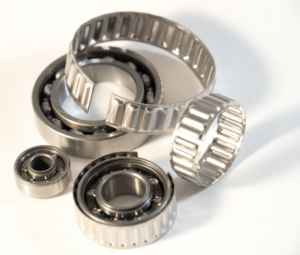
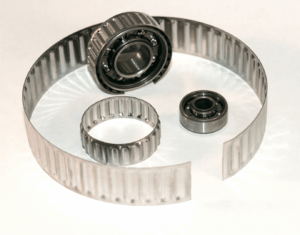
Rolling-element bearings (ball, roller, needle) separate the shaft from the housing with rolling elements running in hardened raceways. Contact is small and repeating, which is why these bearings tolerate high speed and hold tight radial precision. Bushings replace that raceway-and-rolling-element stack with a single sliding interface. Contact area is larger, tolerances are typically looser, and the part count drops to one.
Often, engineers evaluating bearing vs bushing for a new design are really asking about duty cycle. Rolling bearings win on speed, stiffness, low friction, or torque. Bushings frequently win on high load capacity, shock loading, contamination tolerance, and cost. Neither one is the “upgraded” version of the other; they’re built for different load and speed regimes.
Bearings vs Bushings: Matching the Component to the Duty
Bushings tend to be the better fit for slow-speed, high-load, or contamination-prone applications where cost and simplicity matter. Rolling-element bearings tend to win where speed, radial precision, and low starting torque are the priority.
Rolling bearings, by contrast, tend to take over where the application needs sustained high speed, tight axial and radial control, and predictable low-friction startup like precision pumps, spindle drives, and high-speed motors, for example.
A few patterns that hold up across most bearings vs bushings decisions:
- Speed: Sliding contact generates more friction heat as surface speed climbs. Bushings are common in low-to-moderate speed applications; rolling bearings dominate as RPM increases.
- Load type: Bushings handle shock and impact loading well because the load spreads across a continuous surface rather than concentrating on discrete rolling elements. That makes them a natural fit in conveyors, linkages, and heavy-duty pivots.
- Environment: In dirty, dusty, or washdown environments, a simple sleeve with fewer failure points often outlasts a precision rolling-element bearing that’s more sensitive to contamination ingress.
- Cost and space: Bushings are typically lower cost and take up less radial envelope, which matters in compact actuators and fractional-horsepower motors.
This is the part of the bushing vs bearing conversation that most technical content covers well, and for good reason: It’s the first decision an engineer has to make. But it isn’t the last one.
Selecting the Right Component Is Only Step One
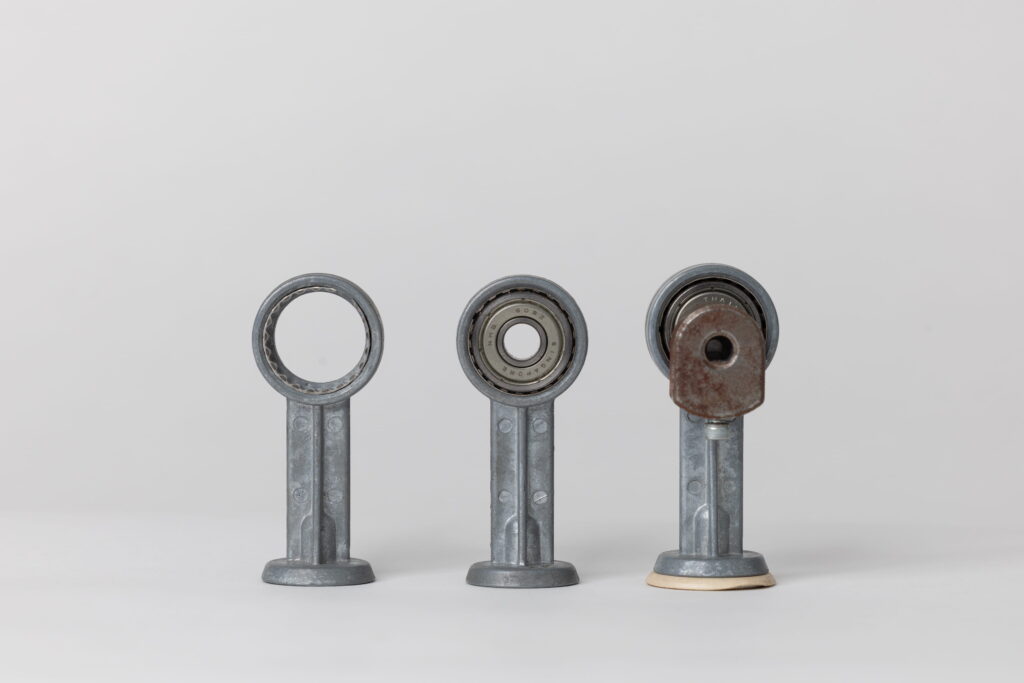
Choosing correctly between a bushing and a bearing doesn’t guarantee a reliable assembly. Both parts still have to be mounted into a housing and retained against a shaft, and that interface carries its own set of failure modes independent of which component was specified.
There are three common approaches to retention and each one carries a known set of tradeoffs.
- Press fits: A straight interference fit between bushing or bearing OD and housing bore transmits load without added hardware. But press fits demand tight machining tolerances on both mating parts, and the assembly force itself can distort a bearing race or bushing bore before the unit ever sees a working load. Over time, tolerance stack-up between the shaft, the housing, and the component itself can turn a “correct” press fit into one that’s too loose to hold or too tight to assemble without damage.
- Adhesives: Structural adhesive bonds close the gap left by looser tolerances and avoid the assembly force problem entirely. The tradeoff is permanence. A bonded joint isn’t serviceable, cure time adds a step to the assembly line, and thermal cycling can degrade the bond faster than the mechanical components it’s holding.
- Loose or clearance fits: Some designs deliberately loosen the fit to simplify assembly. This can influence long-term reliability more than it initially appears to, because a loose fit under dynamic load tends to allow micro-movement between the component and its housing. That micro-movement is a classic setup for fretting—surface wear driven by small, repeated relative motion rather than a single catastrophic event. Fretting is quiet until it isn’t, and by the time it shows up as noise, vibration, or backlash, the interface has usually already lost material.
Each of these methods reduces friction correctly at the bushing or bearing interface and then reintroduces a new reliability question one layer out, at the mounting interface itself.
Tolerance Rings: An Engineered Alternative for Mounting and Retention
A tolerance ring is a radially sprung band, typically stainless steel, installed between a shaft and a bore to create a controlled interference fit. Rather than relying on tight machining tolerances or adhesive bonding, the ring’s wave-form geometry compresses on assembly and generates its own retention force.
That geometry is what separates a tolerance ring from a standard press fit. The waves act as a distributed set of springs around the circumference, which means the ring can absorb a meaningful range of tolerance stack-up between the shaft OD and bore ID without losing its grip and without damaging either mating surface during assembly.
The same compliance that makes assembly easier also addresses several of the failure modes above:
- Thermal expansion: As shaft and housing materials expand and contract at different rates, the ring’s springback maintains contact instead of loosening into a clearance fit or overtightening into a stress condition.
- Torque transmission: The ring transmits torque between shaft and housing through frictional interference, without machining splines or keyways into either part.
- Overload protection: Because the ring is engineered to slip at a defined torque threshold, it can act as a built-in mechanical fuse, protecting the bearing, bushing, or gear train downstream from a torque spike instead of transmitting damage further into the assembly.
- Vibration and micro-movement: The same radial compliance that absorbs tolerance variation also damps the kind of low-amplitude movement that leads to fretting under sustained dynamic load. Because the ring maintains a more consistent retention force across the fit and across the operating temperature range, it reduces the potential for fretting between the bearing or bushing OD and the housing bore in the first place.
None of this replaces the decision an engineer makes when weighing bushing vs bearing for a given duty cycle. It addresses the decision that comes right after: how that component stays in place once it’s installed and running.
If you want the fuller technical picture, including sizing, torque calculations, and material selection, our What Is a Tolerance Ring page covers the mechanics in more depth.
Bearing vs Bushing vs Tolerance Ring at a Glance
| Bearing (Rolling Element) | Bushing (Plain/Sleeve) | Tolerance Ring | |
| Design | Rolling elements (balls/rollers) between inner and outer races | Single-piece sleeve, no rolling elements | Radially sprung band with wave-form projections |
| How It Works | Rolling contact reduces friction | Sliding contact reduces friction | Radial spring interference fit joins components |
| Role in Assembly | Reduces friction at the shaft interface | Reduces friction at the shaft interface | Mounts, retains, and protects the bearing or bushing |
| Best For | High-speed, high-precision rotation | Low-speed, high-load, or contaminated environments | Any assembly needing tolerance compensation, torque control, or removable retention |
| Lubrication | Typically required (grease or oil) | May run dry (polymer/composite) or lubricated | Not a friction-reducing component; no lubrication role |
| Assembly Note | Sensitive to press-fit force during install | Sensitive to press-fit force during install | No press-fit damage, no adhesives, fully removable |
How Tolerance Rings Work in Real Assemblies
Motors, pumps, actuators, and gearboxes all combine a friction-reducing component (bushing or bearing) with a housing that has to hold it in place through vibration, thermal cycling, and load reversals.
In fractional-horsepower motors, a tolerance ring at the bearing OD can control axial position and damp vibration without adding a retaining ring or snap ring to the bill of materials. In compressors and pumps, the same approach compensates for the different expansion rates between an aluminum housing and a steel bearing race across a wide operating temperature range. In gearboxes and drivetrain components, a tolerance ring at a bushing or bearing interface can serve as the torque-overload fuse, protecting downstream gearing from a shock load that would otherwise propagate through the system.
The common thread across these applications isn’t the specific hardware. It’s that mounting bearings and holding bushings and sleeves in place is a design decision with its own failure modes, worth the same level of attention as the bushing vs bearing selection that precedes it.
USA Tolerance Rings: A Domestic Source for Tolerance Ring Engineering
USA Tolerance Rings is the only U.S.-based producer of tolerance rings, manufacturing to IATF 16949:2016 and ISO 9001:2015 standards with a deep domestic stock of 301 stainless steel. That combination is especially helpful for automotive and industrial programs where supply chain traceability and lead time are as much a design constraint as the part itself.
Standard ring geometries cover a wide range of shaft and bore diameters, but tolerance stack-up, torque requirements, and operating environment vary enough between programs that many applications benefit from a custom-engineered solution rather than an off-the-shelf fit. USA Tolerance Rings’ engineering team works directly with design teams from proof of concept through production, which keeps the ring specification tied to the actual application requirements rather than a catalog approximation.
For a closer look at how tolerance rings apply across specific mounting and retention scenarios, mounting bearings and holding bushings and sleeves covers the range of applications in more detail. For further background on plain bearing construction and standard terminology, GlobalSpec’s overview of bushings and sleeve bearings and ASM International’s reference materials on bearing and bushing design are useful starting points.
To learn how tolerance rings support bearing and bushing mounting, torque transmission, and thermal compensation, visit Tolerance Rings 101.
Frequently Asked Questions
Is a bushing a bearing?
Yes. A bushing is a plain bearing. It’s a single-piece sleeve that reduces friction through sliding contact rather than rolling elements. “Bearing” is the broader category that includes both plain bearings (bushings) and rolling-element bearings like ball and roller types.
What is the difference between a bushing and a bearing?
The core difference is contact type: bushings use sliding contact across a continuous surface, while rolling-element bearings use balls or rollers running in raceways. Bushings suit low-speed, high-load, or contaminated environments; rolling bearings suit high-speed, high-precision rotation.
What is a tolerance ring?
A tolerance ring is a radially sprung metal band installed between a shaft and a bore to create a controlled interference fit. It compensates for tolerance stack-up and thermal expansion, transmits torque, and can provide overload protection, all without press-fit damage or adhesives.
How do you mount a bearing without press-fitting?
A tolerance ring installs between the bearing OD and housing bore, generating retention force through its own spring geometry instead of a tight machined interference fit. This avoids the race distortion that can occur during a conventional press-fit assembly.
What is a sleeve bearing?
A sleeve bearing is another name for a bushing, a single-piece plain bearing that supports a rotating shaft through direct sliding contact rather than rolling elements. Sleeve bearings are common in low-speed, high-load, or cost-sensitive applications.
What is a bushing made of?
Bushings are commonly made from bronze, steel, or engineered polymers and composites, sometimes with a self-lubricating liner. Material choice depends on load, speed, operating temperature, and whether the application can tolerate a wet-lubricated interface or needs to run dry.