When Bonding Isn’t Enough: Adhesive Alternatives for Harsh Conditions
When engineers compare adhesive alternatives, the real question is not which retention method is strongest on paper, but which one reaches its performance limit first once real operating conditions are introduced.
Compared to mechanical retention, adhesives often fail first when peel-edge debonding, long-term creep under load (especially with heat), thermal cycling fatigue, or variability in surface preparation dominate the load environment. Mechanical retention often fails first when vibration loosening, fretting, stress concentrations, or tolerance stack-up are not adequately managed. In real assemblies, it’s not headline strength values that predict failure, but the interaction of load type, environment, manufacturing controls, and inspection requirements.
Adhesives are widely used because they distribute load, reduce part count, and simplify assembly. But in dynamic systems like in automotive, electric vehicle, and industrial equipment applications, engineers increasingly encounter performance limits that aren’t obvious during early testing.
Understanding which failure mode appears first (which mechanism degrades retention enough to cause slip, separation, noise, or torque loss) is critical when evaluating adhesive alternatives. This article examines real-world adhesive failure modes, compares them to mechanical retention behavior, and outlines how engineers can best make informed retention decisions in environments dominated by vibration, heat, thermal cycling, and uptime requirements.
Why Adhesives Are Appealing
Structural adhesives are attractive because they provide uniform stress distribution, eliminate fasteners, and allow designers to join dissimilar materials. In controlled conditions, bonded joints can achieve impressive shear strength and fatigue resistance.
However, adhesive performance depends heavily on factors that are difficult to control consistently in production:
- Surface preparation quality
- Bond-line thickness
- Cure time and temperature
- Environmental exposure during service
Standards organizations such as ASTM emphasize that adhesive joints must be evaluated not just for strength, but for creep, fatigue, and environmental durability—variables that are often simplified during early design.
As assemblies move from lab conditions to operating environments, these assumptions are frequently challenged.
Common Adhesive Failure Modes (Creep, Peel, Debonding)
Peel and Edge Debonding
Peel and edge debonding are often the earliest failure modes to appear in rotating or bending-loaded assemblies, because even small edge stresses can initiate separation before bulk adhesive strength is challenged.
Adhesives are strongest when loads are applied evenly in shear across the bonded area, and weakest when loads introduce peel or cleavage stresses that concentrate force at bond edges. In real assemblies, vibration, bending, and misalignment frequently introduce these peel stresses long before shear limits are reached. Once peeling starts, failure often propagates rapidly across the joint.
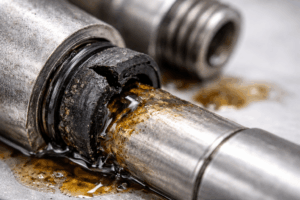
When adhesive failure progresses, fragments or partially cured material can separate from the bond line. In rotating or fluid-handling systems, this debris can migrate into bearings, gears, or flow paths, potentially creating secondary damage beyond simple joint failure.
Creep Under Sustained Load
Adhesives are viscoelastic materials. Under sustained load, particularly at elevated temperature, they deform over time. This creep reduces load-bearing capability even when initial strength appears adequate.
In high-duty or elevated-temperature applications, creep is frequently the first limiting factor over time, even when assemblies never experience overload, making it a dominant long-term failure mechanism in continuously operating electric vehicle motors and industrial equipment.
Creep is also closely tied to bond-line thickness and cure quality. Inconsistent cure profiles or excessive adhesive thickness can accelerate long-term deformation and performance loss.
Thermal Cycling and CTE Mismatch
Thermal cycling adhesive failure is common. Repeated heating and cooling cycles cause bonded materials to expand and contract at different rates due to differences in coefficient of thermal expansion (CTE). Over time, this cyclic strain fatigues the adhesive layer, leading to microcracking, stiffness loss, and eventual debonding.
Under repeated thermal cycling, fatigue from CTE mismatch often becomes the dominant failure mechanism later in service, especially in automotive and electric vehicle applications.
Surface Preparation Variability
Adhesive performance is highly sensitive to surface cleanliness, roughness, and chemistry. NASA guidance on bonded joints highlights that process control (not adhesive strength) is often the limiting factor in joint reliability.
In production environments with multiple shifts, suppliers, or rework loops, maintaining perfect surface prep consistency is difficult. Even minor contamination, residual oils, or improper handling can compromise bond integrity and shorten service life.
Cure Time and Production Constraints
While not a structural failure mode in itself, cure time and process sensitivity often influence whether adhesive failure mechanisms appear earlier than expected in production environments.
Unlike mechanical retention methods, structural adhesives require defined cure times before full strength is achieved. Depending on chemistry and temperature, this can introduce hours (or in some cases days) of production delay before assemblies can be loaded or tested.
While accelerated curing methods exist, they introduce additional process controls and equipment requirements. Variability in cure time, temperature, or mix ratio can result in inconsistent performance from one production batch to another. In high-volume manufacturing environments, these process sensitivities can become a practical limitation independent of the adhesive’s nominal strength.
How Mechanical Retention Fails and Why It’s Different
Mechanical retention methods fail differently than adhesives, and typically under different operating conditions. Instead of gradual strength loss, failures are often tied to load concentration, vibration response, or tolerance interaction.
Common mechanical failure modes include:
- Vibration-induced loosening if retention force is poorly managed
- Fretting wear at rigid interfaces
- Stress concentrations from sharp geometry or keys
- Uneven load sharing due to tolerance stack-up
A key distinction is that adhesive failures often progress invisibly and mechanical failures are more likely to be detected through inspection, noise, or measurable loss of preload before complete separation occurs.
Automotive and EV Reality: Vibration + Thermal Cycling
In automotive applications and especially EV motors, retention methods must survive:
- Continuous vibration
- High duty cycles
- Dissimilar material interfaces
- Repeated thermal expansion and contraction
In these conditions, adhesive weaknesses (creep, peel sensitivity, and thermal fatigue) are often the first performance limits reached unless geometry and process controls are exceptional. As a result, many engineers evaluating adhesive vs. mechanical fastening turn to mechanical retention solutions that can tolerate movement without degrading.
Industrial Reality: Heat, Chemicals, and Uptime
Industrial equipment introduces a different set of pressures:
- Elevated temperatures
- Chemical or moisture exposure
- Long service life
- Maintenance and rework requirements
Here, adhesives may degrade chemically or become impractical due to inspection and service limitations. Mechanical industrial equipment retention methods that allow disassembly and visual verification are often preferred adhesive alternatives in these environments.
Tolerance rings are commonly used in pumps, compressors, conveyors, and rotating industrial equipment because they provide controlled retention while accommodating thermal expansion and vibration.
When to Use Hybrid Approaches
In some applications, engineers combine adhesives with mechanical retention to manage multiple failure risks. Hybrid designs can:
- Reduce vibration while maintaining positional stability
- Provide redundancy in safety-critical joints
- Control peel while mechanical elements carry primary load
However, hybrid solutions add complexity and should be evaluated carefully to ensure that failure modes do not interact in unintended ways.
Designing for Failure
There is no universally “better” retention method, only methods that fail more gracefully under specific conditions. The key is understanding what fails first and whether that failure mode is acceptable, detectable, and manageable.
Relative to mechanical retention, adhesives often fail first when peel stresses, creep, thermal cycling, or process variability dominate the application. Mechanical retention, by contrast, is more likely to reach its limits first when vibration loosening, tolerance mismanagement, or stress concentrations are not addressed in the design. Engineers who account for these realities early can avoid late-stage redesigns and unexpected field failures.
If you’re evaluating adhesive alternatives and want help aligning retention strategy with real operating conditions, tell us about your load, environment, and materials. Our engineers would be happy to provide a recommendation.
Frequently Asked Questions
What is the most common reason structural adhesives fail in production?
The most common reason structural adhesives fail in production is variability in surface preparation, bond-line thickness, or cure conditions, which reduces long-term durability even if initial strength is high.
Do adhesives usually fail in peel before shear?
Yes, adhesives usually fail in peel or cleavage before shear because peel stresses concentrate at bond edges and quickly initiate debonding.
How does temperature affect adhesive strength versus long-term creep?
Temperature affects adhesive strength by accelerating creep and viscoelastic deformation, which reduces load capacity over time even when short-term strength remains acceptable. High temperature adhesive alternatives should be sought out to prevent failure.
How does vibration affect bonded joints compared to mechanically retained joints?
When it comes to vibration failure, adhesive vs. fastener behavior differs. Vibration affects adhesive-bonded joints by introducing peel and fatigue stresses that degrade the adhesive layer, while mechanically retained joints are more likely to experience loosening or fretting that can be inspected and managed.
What are good adhesive alternatives for harsh industrial environments?
Good adhesive alternatives for harsh industrial environments include mechanical retention methods such as tolerance rings, splines, and compliant interference solutions that tolerate heat, vibration, and service requirements.
When does hybrid adhesive and mechanical retention help?
Hybrid adhesive and mechanical retention helps when vibration damping and positional accuracy are both required, or when redundancy is needed in safety-critical assemblies.