Why Press Fits Fail in Rotating Assemblies (and What Engineers Do Instead)
Press fits fail in rotating assemblies because real operating conditions like thermal expansion, vibration, material mismatch, and fatigue erode the interference that press fits rely on for retention. As loads fluctuate and temperatures change, contact pressure drops, slip begins, and damage accumulates.
Common issues:
- Press fits rely on maintained interference, which operating conditions often reduce
- Thermal expansion mismatch can lower contact pressure at operating temperature
- Vibration-driven micromotion can trigger fretting that accelerates slip
- Tolerance stack-ups make press fit performance inconsistent at scale
- Compliant retention (e.g., tolerance rings) can maintain contact under variability
Press fits have long been a default choice for securing bearings, hubs, gears, and rotors. On paper, the application appears simple: calculate interference, apply force, and achieve torque transmission through friction. But in practice, rotating assemblies rarely operate under the stable, idealized conditions assumed during design.
This is why many engineers are seeking out press fit alternatives designed to adapt under dynamic conditions rather than resist them rigidly.
Why Press Fits Are Used in the First Place
Press fits became a standard solution in rotating assemblies because they offer a compact, fastener-free way to transmit torque and maintain concentricity. When properly sized, the friction generated by interference between the shaft and housing can provide reliable retention without additional components, machining features, or secondary operations.
From a design standpoint, press fits are appealing because they are:
- Simple to model and specify
- Space-efficient in compact assemblies
- Familiar to manufacturing team
- Cost-effective at low to moderate production volumes
In controlled environments where materials are well matched, tolerances are tightly held, temperatures are stable, and loads are predictable, press fits can perform adequately for the life of the product. Many engineering standards and legacy design references are built around these assumptions.
The challenge is that rotating assemblies rarely operate under such idealized conditions. As speed, load variability, temperature cycling, and service life increase, the limitations of rigid interference fits become more pronounced.
The Real-World Conditions That Cause Press Fit Failures
Thermal Expansion Reduces Interference
Press fits depend entirely on maintained interference. In rotating systems, temperature changes are unavoidable. Shafts heat from friction and load and housings heat unevenly due to airflow and mass differences.
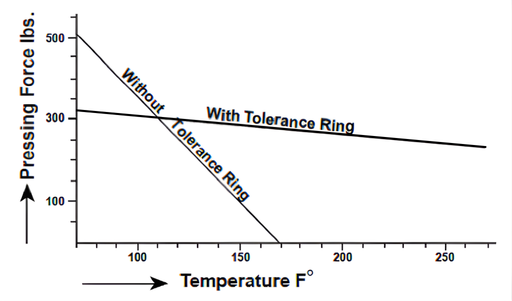
When shaft and housing materials expand at different rates, interference can decrease or disappear entirely at operating temperature. Even small changes in contact pressure can dramatically reduce torque capacity. Over time, repeated thermal cycling accelerates loss of retention and surface damage.
Vibration and Micromotion Lead to Fretting
Rotating assemblies are rarely perfectly balanced. Vibration introduces micromotion at the interface, even when nominal interference is present. This micromotion causes fretting wear, generating debris that further reduces friction and accelerates slip.
Once fretting begins, press fit performance degrades rapidly. Engineers often observe that assemblies pass initial testing but fail after extended runtime—an outcome tied directly to vibration-induced interface damage.
Tolerance Stack-Ups Undermine Consistency
Press fits assume tight control over shaft and bore dimensions. In real production environments, variation is inevitable, especially when multiple suppliers or manufacturing locations are involved.
Worst-case tolerance conditions can result in:
- Excessive interference, increasing assembly force and risk of cracking
- Insufficient interference, leading to early slip or noise
- Inconsistent performance across builds
Designs that rely on nominal dimensions often appear sound in CAD but fail statistically in production.
High Assembly Stress Creates Hidden Damage
To compensate for torque requirements, engineers may increase interference. This raises assembly force and internal stress, which can cause galling, microcracking, or distortion, particularly in thin housings or brittle materials.
These defects may not be visible during assembly but can propagate under cyclic loads, ultimately causing catastrophic failure.
Why Traditional Fixes Fall Short
When press fit failures appear, common responses include tighter tolerances, adhesives, splines, or knurling. Each introduces tradeoffs:
- Tighter tolerances increase cost and scrap risk
- Adhesives complicate assembly, limit rework, and degrade with heat
- Splines and keys add stress concentrations and require more space
- Knurling introduces variability and surface damage
These approaches attempt to reinforce a rigid interface rather than address the underlying problem: Rotating assemblies require adaptability.
What Engineers Are Doing Instead
As rotating systems become faster, lighter, and more thermally dynamic, engineers are increasingly moving away from retention methods that depend on fixed interference alone. Rather than attempting to eliminate all movement at the interface, modern designs often incorporate elements that can adapt to real operating conditions.
This shift reflects a broader design philosophy change: from maximizing static stiffness to managing dynamic behavior.
Tolerance rings are one of the most widely adopted press fit alternatives in this context. Instead of relying on a single interference value, tolerance rings introduce engineered radial compliance through a corrugated, spring-like geometry. This allows the interface to maintain consistent contact pressure even as conditions change.
In practice, engineers use tolerance rings to:
- Absorb vibration without concentrating stress
- Maintain torque transmission across tolerance variation
- Accommodate thermal expansion and contraction
- Reduce fretting and surface damage
- Enable rework or service without scrapping parts
Because tolerance rings behave elastically rather than plastically, they offer a controlled response to load and motion—something press fits cannot do once interference begins to degrade.
How Tolerance Rings Perform in Rotating Assemblies
Unlike press fits, tolerance rings do not rely on rigid interference alone. Their performance comes from engineered flexibility.
In rotating systems, tolerance rings:
- Maintain consistent contact pressure across tolerance variation
- Absorb vibration and reduce fretting through controlled compliance
- Accommodate thermal expansion without losing retention
- Distribute load more evenly along the interface
- Allow rework and service without damage to mating parts
This behavior makes them particularly effective in pumps, compressors, conveyors, and other demanding rotating applications where press fits frequently underperform.
When Press Fits Do/Don’t Make Sense
Press fits still have a place in mechanical design, but their suitability depends heavily on application context.
Press fits tend to make sense when:
- Operating temperatures are stable and well below material limits
- Rotational speeds are low to moderate
- Torque loads are predictable and largely static
- Assemblies are not intended to be serviced or reworked
- Tolerances are tightly controlled within a single manufacturing environment
In contrast, press fits often struggle when:
- Assemblies experience thermal cycling or uneven heating
- Vibration or dynamic loading is present
- Materials with different expansion rates are paired
- Production variability cannot be tightly constrained
- Long service life or repeated load cycles are expected
In these scenarios, the rigid nature of press fits becomes a liability rather than an advantage. Designs that appear robust during initial assembly or testing may degrade gradually in the field, leading to slip, noise, or premature failure.
Designing for Rotation Means Designing for Reality
Rotating assemblies operate in a world of variability. Heat, motion, tolerance stack-ups, and fatigue are unavoidable. The question is not whether these factors will appear, but whether the joint design can accommodate them without losing performance.
Press fits rely on maintaining a fixed condition that real systems rarely preserve over time. That is why many engineers now evaluate retention methods based on how they behave in service, not just at assembly.
Tolerance rings offer a practical alternative by introducing controlled compliance where rigid interference falls short. By managing load, vibration, and thermal effects rather than resisting them outright, they enable more stable, repeatable performance in demanding rotating systems.
To learn more about how tolerance rings work and where they are used, visit USAToleranceRings.com.
Frequently Asked Questions
Why do press fits fail in rotating assemblies?
Press fits fail in rotating assemblies because thermal expansion, vibration, and tolerance variation reduce interference over time, leading to slip, fretting, and loss of retention.
What causes press fit failures under dynamic loads?
Press fit failures under dynamic loads are caused by micromotion at the interface, fretting wear, and fatigue driven by vibration and fluctuating torque.
What are common press fit alternatives for rotating assemblies?
Common press fit alternatives for rotating assemblies include tolerance rings, splined interfaces, adhesives, and keyed joints, with tolerance rings offering adaptability and reworkability.
Can tolerance rings replace press fits in rotating components?
Yes, tolerance rings can replace press fits in rotating components by providing controlled radial force, accommodating thermal expansion, and maintaining consistent performance under vibration.
Where are tolerance rings most effective compared to press fits?
Tolerance rings are most effective compared to press fits in pumps, compressors, conveyors, motors, and other rotating assemblies subject to thermal cycling and variable loads.