A Spring-like Interface that Keeps Bearings Secure Through Heat Cycles
Thermal expansion is one of the most common and destructive challenges in bearing assemblies. When a steel ball bearing is mounted into a housing made of aluminum, magnesium, or plastic, differences in the coefficients of thermal expansion (CTE) can quickly compromise the integrity of the fit.
At room temperature, a press fit (PF) may seem perfectly secure. But as the system heats up, the housing expands more than the steel bearing, reducing the interference. The result: reduced retention force, outer race slippage, and eventual destruction of both the bearing and housing.
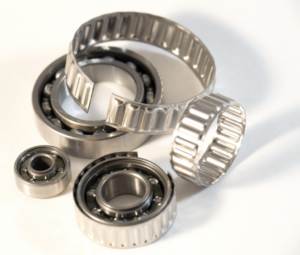
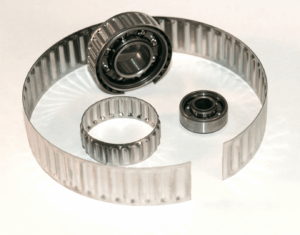
Tolerance rings provide an alternative approach. By introducing a spring-like interface between the bearing and housing, they maintain retention forces even under extreme temperature swings.
This article explores the mechanics, equations, and a real-world example of how tolerance rings address thermal expansion failures in bearing assemblies.
The Mechanics of Press Fits
A press fit works by creating an interference between the outer diameter of the bearing and the inner diameter of the housing. The retention force depends on:
- The degree of interference
- The modulus of elasticity (E) of the housing material
- The friction coefficient (μ) between the bearing and housing
While effective at room temperature, press fits have a critical weakness: They rely on dimensional stability. If the housing expands more than the bearing, the interference reduces. In cases where aluminum (CTE ≈ 23 × 10⁻⁶ /°C) is paired with steel (CTE ≈ 12 × 10⁻⁶ /°C), the difference is significant. For large bearings, even a modest temperature rise can cause complete loss of retention.
This failure mode is not gradual. Once slippage begins, wear accelerates rapidly. Bearings lose concentricity, vibration increases, and surfaces are damaged.
Reference: Coefficient of Thermal Expansion
Tolerance Ring Fundamentals
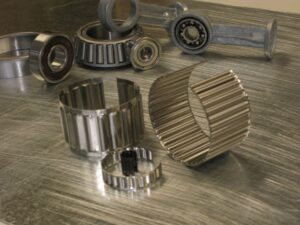
Tolerance rings introduce compliance into the interface. Instead of a rigid interference, tolerance rings rely on corrugations or “waves” that act like springs around the circumference. When compressed between the bearing and housing, these waves generate radial holding forces.
Each wave acts like a miniature spring, and together they distribute load evenly around the circumference. The combined spring effect provides enough force to retain the component securely while still allowing for controlled movement when expansion, vibration, or misalignment occurs.
Engineers can estimate performance in early design stages using simplified spring models, considering factors such as material modulus, wave geometry, thickness, and pitch. In practice, manufacturing variations and localized thickness changes require validation testing, but these models provide reliable guidance for selecting and sizing rings.
Example: 6205 Ball Bearing in Aluminum Housing
The effect of tolerance rings becomes clear in real-world comparisons. Consider a 6205 ball bearing (≈ 2.00″ OD) mounted in an aluminum housing:
- Press fit only:
- 0.0012″ interference fit
- Installation force: 500 lbs
- Retention fails at 170°F due to differential thermal growth
- With tolerance ring:
- Installation force reduced to 320 lbs
- Retention force remains 230 lbs even at 270°F
In other words, the press fit failed before 200°F, while the tolerance ring maintained reliable retention for another 100°F higher, with lower assembly stress.
For engineers designing equipment exposed to thermal cycling, from automotive underhood systems to industrial pumps, this improvement directly translates into longer service life and fewer warranty issues.

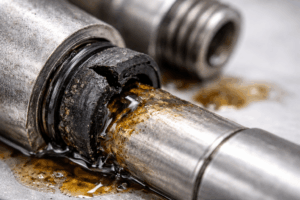
Related Application: Pump Bearing Failures
Aluminum housings paired with steel bearings often lose retention under heat, leading to leakage,
vibration, and costly downtime.
Material Considerations
The choice of tolerance ring material influences both performance and operating limits. Common options include:
- 301 Stainless Steel (SST): Stable up to 450°F, excellent corrosion resistance, balanced spring properties
- Hardened Carbon Steel: Stable up to 250°F, higher spring rate and radial capacity
- 316/316L Stainless Steel: Softer spring properties, higher corrosion resistance
- Exotic Alloys (Hastelloy® C-276, Monel® K-500): Extreme temperature and chemical resistance
Selecting the right material involves balancing spring rate, corrosion resistance, and operating temperature.
Design Implications for Engineers
Tolerance rings offer several engineering advantages over traditional press fits:
-
Improved thermal resilience
- Retention maintained across wider temperature ranges
- Especially beneficial in mixed-material assemblies
-
Reduced assembly force
- Lower press-in loads reduce risk of housing damage
- Enables use with lightweight or thin-wall housings
-
Extended bearing life
- Reduced risk of raceway slippage
- Lower vibration due to compliant mounting
-
Relaxed machining tolerances
- Accommodates greater variation in component dimensions
- Eases production by reducing precision machining requirements
By incorporating tolerance rings early in the design process, engineers can eliminate one of the most common failure points in bearing assemblies without adding significant complexity and cost.
Final Word: Press Fit vs. Tolerance Ring
Thermal expansion presents a fundamental challenge in mixed-material bearing assemblies. While press fits are effective under controlled conditions, they lose reliability as soon as temperature variation enters the equation.
Adding compliance and spring behavior to the interface addresses this weakness. With proven retention under thermal cycling, lower assembly force, and material options for environments up to 450°F, tolerance rings provide a robust and flexible solution.
For engineers tasked with designing rotating equipment, automotive systems, or industrial assemblies exposed to temperature swings, tolerance rings represent both a performance upgrade and an opportunity to reduce failure costs.
Recommendation: If you are new to tolerance rings or evaluating them for the first time, contact our engineering team. We will help you define the right ring for your specific application, taking into account tooling, pitch, material behavior, and other critical design factors.
FAQs: Thermal Expansion and Tolerance Rings
Why do press fits fail under thermal cycling?
Press fits fail under thermal cycling because housing materials like aluminum expand faster than steel, the interference fit is lost, causing slippage and failure.
How do tolerance rings solve thermal expansion issues?
Tolerance rings solve thermal expansion issues by using corrugated “waves” that act like springs, maintaining consistent retention forces even when components expand differently.
What is the maximum operating temperature of tolerance rings?
Standard stainless steel rings are stable up to 450°F, while exotic alloys can handle more extreme environments.
Do tolerance rings reduce assembly force?
Yes, they typically require 30–40% less press-in force compared to traditional interference fits.
In what applications are tolerance rings most beneficial?
They are especially useful in automotive underhood systems, industrial pumps, motors, and mixed-material bearing housings exposed to wide temperature swings.