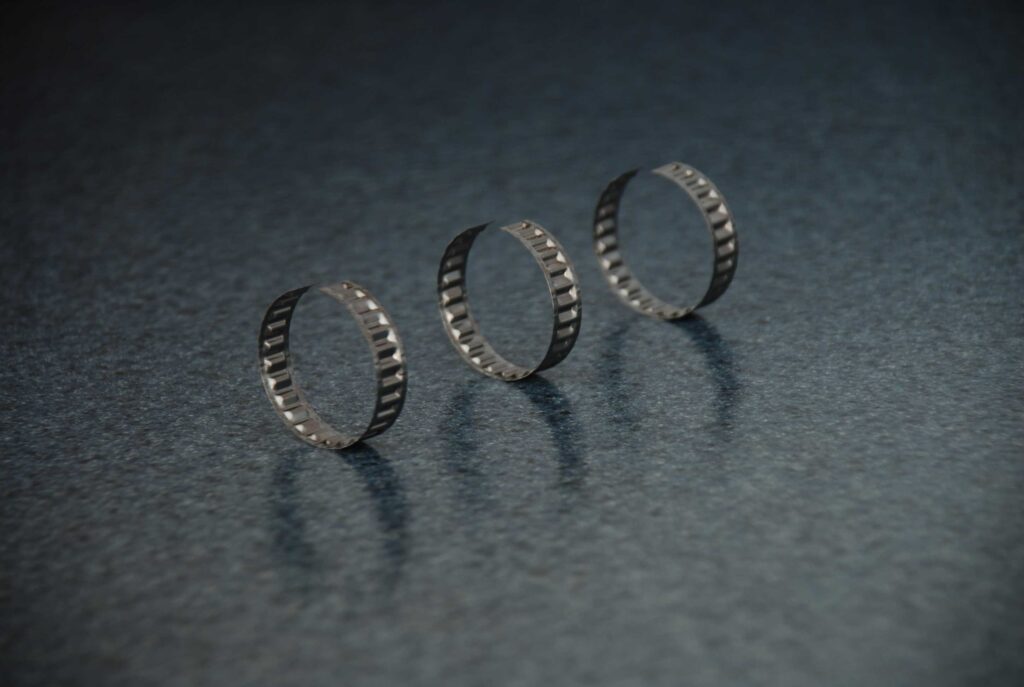
Tolerance rings are deceptively simple components: thin, corrugated metal rings that sit between two cylindrical parts to create a controlled interference fit. But behind that simplicity is a significant amount of material science and mechanical engineering. The rings’ performance depends entirely on their ability to behave like a precision spring, deflecting predictably, maintaining retention force, and recovering its shape over thousands (even millions) of load cycles.
For decades, both 301 stainless steel and high-carbon spring steels (typically 1074 or 1075) have been used to manufacture tolerance rings. Yet in nearly every modern, high-duty application—from fractional horsepower motors to automotive bearing retention—301 stainless steel has become the preferred choice. The reason is straightforward. It delivers more reliable spring performance, longer life, greater environmental stability, and more predictable behavior in production.
This article explains why, and how engineers can make informed choices when specifying materials for new designs.
Why Material Choice Matters in a Tolerance Ring
A tolerance ring works by generating radial force through its waves (corrugations). As the host and inner components assemble, the waves compress, and the ring acts as a spring that pushes the two cylindrical surfaces apart.
A well-designed ring must maintain:
- Predictable radial capacity
- Stable geometry
- Strong elastic recovery
- Long-term resistance to wear, vibration, and environmental exposure
The choice of material helps determine how well a ring can deliver all of this over the course of the product’s life.
Carbon steel can meet basic spring requirements. But the more demanding the environment (temperature swings, vibration, humidity, or long duty cycles) the more that carbon steel’s limitations will affect overall system performance.
This is where 301 stainless steel’s material advantages matter.
The Spring Performance Advantage of 301 Stainless Steel
The most important property of any tolerance ring material is its ability to behave elastically. A ring that permanently deforms or loses force can compromise the entire assembly. 301 stainless steel achieves high yield strength through cold working, a mechanical strengthening process that increases hardness and stiffness while maintaining useful ductility.
This cold-worked structure enables consistent spring behavior and reliable elastic recovery across repeated compression cycles. In many tolerance ring applications, 301 stainless steel provides stable force retention, resists taking a permanent set, and maintains its designed force curve and geometry, even in assemblies subjected to vibration or micro-motion. In motors, blower assemblies, and other rotating equipment where tolerances are tight and movement is continuous, this consistency in elastic performance is critical.
Heat-treated carbon spring steels can deliver higher absolute strength and torque capacity, but their performance depends heavily on heat-treat condition and process control. In high-volume production, this can introduce variability in spring behavior and torque response. As a result, material selection often becomes a tradeoff between maximum strength and long-term consistency, corrosion resistance, and predictable elastic performance.
Corrosion Resistance and Reliability in Real-World Assemblies
Carbon steel’s most significant drawback is its complete lack of corrosion resistance. Left untreated, it oxidizes quickly. For a tolerance ring installed between two critical surfaces and expected to maintain a precise frictional interface, this poses major challenges. Carbon steel rings require plating or coating to survive the operating environment. Plating adds cost, introduces another processing step, and can chip, crack, or wear through during assembly or service.
Once plating begins to fail, fretting corrosion accelerates. The ring loses force, the surfaces wear prematurely, and the assembly’s reliability deteriorates.
301 stainless steel eliminates this entire failure mode. Its chromium content makes it inherently resistant to oxidation and surface corrosion, even in tight, confined interfaces where micro-motion can occur. This is a major reason stainless rings dominate in outdoor environments, sealed motor housings, humid applications, and any design where service life or warranty performance is a priority.
Consistency Over Temperature and Time
Tolerance rings are often placed in environments where temperature fluctuates (down-hole pumps or aerospace applications, for example). Motors heat during operation. Bearings transfer thermal energy from shafts. Assemblies may cool rapidly in outdoor or seasonal conditions. These cycles can cause materials to expand, contract, and fatigue.
301 stainless steel maintains stable mechanical properties across a wider temperature range than carbon steel. That means the spring behavior of a stainless ring remains consistent, even as the surrounding assembly cycles repeatedly between hot and cold states.
Carbon steel, especially when plated, simply has more variables working against it: plating adherence, thermal expansion differences between substrate and coating, and fatigue at the wave peaks where stresses concentrate.
For assemblies where stability is critical, such as maintaining bearing preload in a long-life motor, stainless steel provides measurably better performance over time.
Manufacturing Reliability and Lead Time
Because carbon steel tolerance rings require post-forming heat treating, their production has more process steps and they take longer to produce. Plus, each additional step increases cost variability and scrap risk. In high-volume manufacturing, even small fluctuations can cause significant delays.
301 stainless steel streamlines production. It can be formed, tempered for spring properties, and shipped without any coating processes. That means:
- Faster lead times
- Fewer opportunities for process defects
- Less batch-to-batch variation
- Confidence during production the part approval process, qualification, and ramp-up
Stainless also tends to be more available from domestic suppliers, reducing procurement delays. This is an especially significant advantage during periods of global supply disruption.
For additional reading on how steel cleanliness and processing affect material performance consistency, USA Tolerance Rings’ parent company Sullivan Steel provides helpful insights.
Total Cost of Ownership: Why Stainless Pays for Itself
At first glance, carbon steel appears cheaper. But when the full lifecycle cost is considered, stainless steel typically wins.
A stainless steel tolerance ring reduces or eliminates costs associated with:
- Plating
- Plating failures
- Corrosion-related returns
- Force variability
- Assembly rework
- Premature field failures
- Warranty claims
For high-duty cycles or equipment designed to last tens of thousands of hours, the long-term economic advantage is obvious. Engineers often find that stainless steel materially reduces total system cost, even if the ring itself costs slightly more upfront.
301 Stainless Steel vs. Carbon Steel for Tolerance Rings
| Feature | 301 Stainless Steel | High-Carbon Spring Steel (1074/1075) |
| Spring performance | Higher yield strength via cold work; strong elastic recovery | Can meet spring needs, but more risk of fatigue or permanent set over time |
| Force consistency | More predictable behavior across production volumes | Heat-treat process can introduce variability batch-to-batch |
| Corrosion resistance | Inherently corrosion resistant; no plating required | No inherent corrosion resistance; typically requires plating or coating |
| Reliability in service | Lower risk of fretting and corrosion-driven force loss | Plating can chip, crack, or wear; fretting corrosion can accelerate once coating fails |
| Thermal cycling stability | Stable spring behavior across temperature swings | More variables from plating adherence and differential expansion |
| Manufacturing complexity | Streamlined; fewer processing steps | More steps including post-forming heat treat and often plating |
| Lead time risk | Generally shorter and more predictable | Can be longer due to additional processing and scrap risk |
| Best-fit applications | Vibration, thermal cycling, humidity, dynamic loads, precision assemblies | Basic, low-movement, cost-sensitive, controlled environments |
| Total cost of ownership | Lower over lifecycle due to reliability and corrosion resistance | Lower upfront cost but higher risk of lifecycle-related expenses |
Where Stainless vs. Carbon Steel Make the Most Sense
Carbon steel still has a place in tolerance rings, but only in the right applications. Basic, low-movement, cost-sensitive designs can benefit from carbon steel’s lower raw material price as long as environmental conditions are controlled and performance demands are modest. They’re also more appropriate than stainless steel would be for applications that require torque slip.
For any design involving vibration, thermal cycling, humidity, dynamic loads, or precision assembly, 301 stainless steel is the material that consistently delivers the retention force, durability, and reliability expected from a well-engineered tolerance ring.
For engineers evaluating specific material options, USA Tolerance Rings provides detailed performance data in its catalog.
Why 301 Stainless Steel Remains the Superior Material
Tolerance rings may be small, but their material properties have an outsized impact on system performance. While carbon steel can work in simple, static applications, 301 stainless steel provides superior spring performance, corrosion resistance, long-term stability, and reliability—attributes that are essential in today’s high-precision, high-duty assemblies.
For OEMs designing motors, bearings, rotating equipment, or any product expected to withstand vibration and thermal variation, stainless steel is the safer choice.
FAQ
Q: What is the best material for tolerance rings?
A: 301 stainless steel is generally the best material choice for tolerance rings because it provides superior spring strength, corrosion resistance, and lifecycle performance compared to carbon steel. In basic, low-movement designs that will be placed in well-controlled environmental conditions and modest performance demands, carbon steel can provide an adequate, cost-saving alternative.
Q: Why is stainless steel more reliable than carbon steel in tolerance ring applications?
A: Stainless steel is more reliable than carbon steel in tolerance ring applications for two reasons First, its cold-worked structure offers higher yield strength and better elastic recovery. Secondly, its corrosion resistance eliminates plating failures and long-term degradation.
Q: Does stainless steel reduce manufacturing lead time?
A: Yes, stainless steel can often reduce manufacturing lead time. It does so by eliminating the plating step required for carbon steel, which reduces processing time and production variability.
Q: When is carbon steel appropriate?
A: Carbon steel is suitable for basic, low-movement applications where corrosion, vibration, and fatigue are not major concerns.