How to Design a Tolerance Ring: Materials, Torque, and Risk
Designing a tolerance ring correctly starts with clearly defined application requirements. At USA Tolerance Rings, our engineers work from your product specifications to define torque requirements, evaluate material and environmental conditions, and account for tolerance variation at the interface. These three factors determine whether a tolerance ring will deliver consistent torque, survive temperature changes, and perform reliably across real-world manufacturing variation.
In practice, tolerance ring specification often happens late—after a fit issue appears, torque drops in testing, or assembly becomes inconsistent. At that point, engineers are forced to work within constraints that weren’t designed with the tolerance ring in mind.
This guide can help you prevent that scenario, walking through how to design a tolerance ring for an application before you’re too far into the process. It focuses on the decisions that actually shape performance:
- How much torque is required
- How materials behave under load and temperature
- How tolerance stack-ups affect contact pressure
- Where design assumptions commonly break down
The goal is to help engineers surface risk early, while changes are still easy and inexpensive to make, rather than discovering issues during validation or production.
Why Tolerance Ring Specification Is Often Underestimated
Tolerance rings are frequently selected late in the design process as a fix for loose fits, torque loss, or assembly challenges. But treating them as generic mechanical fastening solutions introduces risk. Torque capacity, spring behavior, and long-term performance are highly sensitive to material choice, wave geometry, mating component tolerances, and operating environment.
Many legacy references focus on isolated variables like torque equations, spring constants, or friction coefficients without showing how those variables interact in real assemblies. Engineers are left to interpolate assumptions across disciplines. This article bridges that gap with a decision-driven roadmap grounded in real application constraints.
Step-by-Step Design Walkthrough
1. Define Torque and Load Requirements
The first and most constraining factor in tolerance ring selection is torque. Engineers should define not only the required torque value, but how that torque behaves over time.
Key questions include:
- Is the torque static, cyclic, or increasing with use?
- Is slip acceptable under overload conditions?
- Does torque retention matter more than peak torque?
Higher torque requirements typically demand increased radial force, which reduces tolerance forgiveness. NASA technical guidance on interference fits and spring elements highlights how friction-based retention mechanisms are sensitive to contact pressure and surface condition, not just geometry. Designs that ignore this relationship often show early torque loss or inconsistent performance across builds.
For deeper technical context on torque behavior, see the NASA reference on joint mechanics.
2. Evaluate Material Selection and Interfaces
Material choice directly affects spring performance, corrosion resistance, and thermal stability. Stainless steel tolerance rings (particularly 301 stainless) offer superior elastic recovery, fatigue resistance, and corrosion performance compared to carbon steel options.
Material pairing matters just as much as ring material itself:
- Steel-to-steel interfaces behave differently than steel-to-aluminum ones
- Plastic housings introduce creep and relaxation concerns
- Dissimilar metals amplify thermal expansion effects
USA Tolerance Rings provides deeper material performance comparisons of 301 stainless vs. carbon steel to support informed selection.
When temperature enters the equation, material choice becomes even more critical. Thermal expansion mismatches can either increase interference beyond safe limits or eliminate contact pressure entirely at operating temperature. ASM International data on material behavior at temperature reinforces why thermal considerations must be addressed early, not validated after testing.
3. Account for Tolerances and Manufacturing Variability
Tolerance rings exist because real parts vary, but that doesn’t mean variability can be ignored. Engineers should evaluate based on worst-case interference, not nominal dimensions.
Key considerations:
- Are shaft and bore tolerances tightly controlled or supplier dependent?
- Does performance depend on minimum interference?
- Will multiple manufacturing locations introduce variation?
Designs that only function at nominal dimensions are rarely robust in production. Wave geometry helps maintain contact pressure across tolerance stack-ups, but only within defined limits. Early evaluation prevents designs that appear sound in CAD but fail statistically in manufacturing.
For foundational insight into tolerance ring behavior, see our technical documentation online.
4. Assess Environmental and Operating Conditions
More than torque alone, it’s the environment that often dictates tolerance ring design considerations. Vibration, corrosion, temperature cycling, and service life all influence spring behavior and long-term retention.
Engineers should explicitly identify:
- Elevated or fluctuating temperatures
- Dynamic loading or vibration exposure
- Expected service life and cycle count
- Presence of contaminants or corrosive media
In bearing applications, thermal expansion and dynamic loads are especially influential. Explore the effects in our guide on tolerance rings in ball bearing applications.
5. Consider Assembly and Service Requirements
Specification doesn’t end at performance. Assembly force, repeatability, and serviceability often determine whether a design succeeds in production.
Questions to resolve include:
- Must assembly be fast or automated?
- Is rework or service required?
- Are adhesives or traditional fasteners constrained?
Tolerance rings are frequently chosen to simplify assembly, but improper specification can negate that benefit through excessive insertion force or inconsistent results across operators.
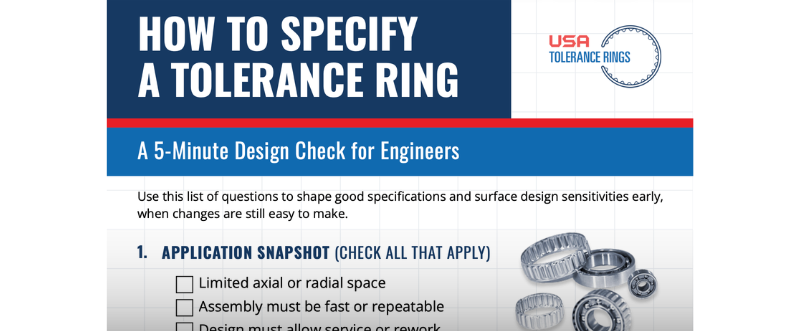
Download Our 5-Minute Design Check for Engineers
Common Tolerance Ring Design Mistakes (and Why They Happen)
Most tolerance ring issues don’t stem from incorrect calculations. They come from assumptions that were never stress-tested against real operating conditions. These mistakes are common even in experienced engineering teams, especially when tolerance rings are introduced late in the design cycle.
Some of the most frequent design pitfalls include:
- Designing around nominal dimensions only
Assemblies that work at nominal shaft and bore sizes often fail under worst-case tolerance conditions. Robust designs must account for variation, not ideal geometry. - Treating torque as a single static value
Torque requirements change over time due to wear, vibration, and thermal cycling. Ignoring how torque behaves in service can lead to early performance loss. - Overlooking thermal expansion effects
Differences in thermal expansion between shafts, housings, and the tolerance ring itself can dramatically alter interference and contact pressure at operating temperature. - Assuming all tolerance rings behave the same
Material, wave geometry, and spring characteristics vary widely. Substituting one ring for another without reevaluating performance can introduce hidden risk. - Waiting until testing or production to involve application engineers
By the time problems appear in validation, design flexibility is limited. Early review helps align assumptions with real-world constraints.
Addressing these issues early reduces complexity by preventing redesign, requalification, and production delays later.
When to Get Support from Engineering
If torque retention, temperature effects, or tolerance sensitivity are unclear, or if multiple tradeoffs are competing, early collaboration reduces risk. Application-level guidance helps translate requirements into manufacturable, repeatable designs before costly iteration.
We’re here to help you navigate your fastener needs. To see how we can solve your engineering needs through a custom solution, fill out the New Product Information Form at: usatolerancerings.com/custom-design.
Frequently Asked Questions
How do I design a tolerance ring for my application?
To design a tolerance ring for a particular application, engineers must define torque and load requirements, evaluate material and temperature effects, and assess tolerance variability to ensure consistent performance.
How do torque requirements affect tolerance ring selection?
Torque requirements affect tolerance ring selection by determining the necessary radial force, which directly influences spring stiffness and tolerance flexibility.
What materials are best when designing a tolerance ring?
The best materials when designing a tolerance ring depend on environment and performance needs, but stainless steel options like 301 stainless typically provide superior elasticity, fatigue resistance, and corrosion performance.
How do tolerances impact tolerance ring performance?
Tolerances impact tolerance ring performance by changing interference levels; designs must function across worst-case conditions, not just nominal dimensions.
Can tolerance rings handle thermal expansion?
Tolerance rings can handle thermal expansion when material choice and geometry are matched to operating temperature, accounting for differential expansion between mating components.