Keyless Shaft Connections for Smoother, More Reliable Machines
How Tolerance Rings Reduce Vibration and Eliminate Keyway Damage
Keyless shaft connections are replacing traditional keyed and press-fit designs across pumps, compressors, and conveyors. By eliminating keyways and rigid fits, engineers unlock smoother operation, easier maintenance, and more precise timing control.
While most keyless systems rely on external collars or locking devices, tolerance rings build that functionality right into the interface, which in turn, simplifies assembly and improves balance. Instead of cutting a keyway that weakens the hub, tolerance rings create a spring-like interface that transmits torque evenly while maintaining perfect alignment.
The result: reduced vibration, less wear, and a longer-running machine.
Keyed vs Keyless Shaft Connections: The Hidden Costs of Keys and Press Fits
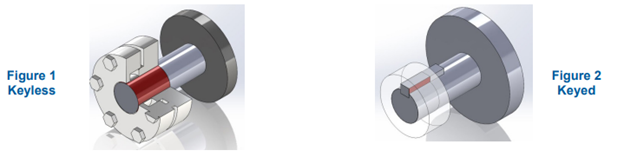
Keyways have long been the default for coupling shafts and hubs. They’re simple, cheap, and familiar, but they come with mechanical penalties that show up later in the life of the equipment. Penalties like:
- Stress risers: Keyways introduce sharp geometry that concentrates stress in thin or lightweight hubs
- Hub scoring and distortion: Heavy press fits often gall the bore during assembly or disassembly
- Misalignment: Even small errors in machining or key placement lead to runout and vibration
- Timing drift: Keys and splines can allow minute backlash, affecting precise phasing in rotating assemblies
As systems become smaller, faster, and lighter, those weaknesses multiply. Keyless alternatives, like locking assemblies, shrink discs, and tolerance rings, offer ways to transmit torque without weakening the hub.
Why Traditional Keyless Shaft Connections Fall Short in Modern Equipment
In pumps, compressors, and conveyors, the mechanical environment is unforgiving:
- Thin impellers and rotors can’t tolerate deep keyways
- High-speed shafts magnify small misalignments into vibration and bearing wear
- Thermal cycling loosens rigid fits over time
- Noise and imbalance creep in as assemblies wear or shift
Even precision-machined keyed joints can lose concentricity as components expand, contract, and flex under load. Engineers now look for keyless methods that maintain alignment dynamically, not just at assembly.
How Tolerance Rings Become a Built-In Keyless Shaft Connection
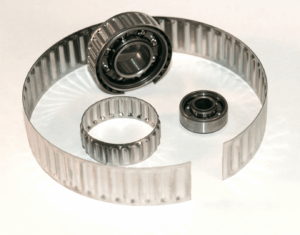
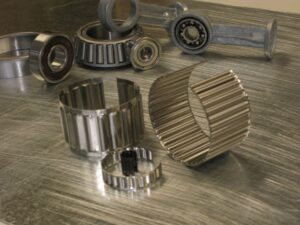
A tolerance ring is a thin metallic band with precision-formed corrugations (waves). It sits between the shaft and hub, acting as a compliant interface. When assembled, these corrugations compress slightly, generating radial pressure that:
- Holds the hub securely and concentrically on the shaft
- Allows small amounts of radial deflection for thermal expansion or shock loads
- Transmits torque through uniform friction, not rigid mechanical engagement
This makes the tolerance ring a built-in form of keyless connection that requires no external hardware, no keyway cuts, and no heavy interference fits.
While traditional keyless locking devices rely on bolt-on collars or shrink discs, tolerance rings deliver the same principle within the mating interface itself—saving space and simplifying assembly.
Advantages of Tolerance Ring Keyless Connections
| Feature | Keyed Fit | Locking Device (Bolt-On) | Tolerance Ring |
| Hub stress | High (stress riser at keyway) | Moderate | Evenly distributed |
| Concentricity | Depends on machining | Good | Self-centering |
| Vibration damping | None | Minimal | Excellent (spring interface) |
| Serviceability | Difficult / destructive | Moderate | Easy, non-destructive |
| Thermal expansion | Limited | Limited | Self-compensating |
| Assembly complexity | Simple | Complex (multi-piece) | Simple press fit |
Tolerance rings provide compact, self-centering, and vibration-damping torque transfer, without the bulk or cost of external locking assemblies.
Applications: Keyless Shaft Connections in Pumps, Compressors, and Conveyors
Pump Impellers
Thin impeller hubs can’t afford to lose strength from keyways. Tolerance rings allow a smooth, evenly distributed fit that maintains perfect concentricity, reducing vibration and extending bearing life.
Compressor Rotors
Precise timing between compressor rotors depends on exact angular alignment. Tolerance rings enable backlash-free connections that resist loosening through repeated thermal cycles.
Conveyor and Drive Systems
In conveyors with synchronized drives, the spring-like interface of a tolerance ring absorbs torsional vibration and keeps timing consistent under dynamic loads.
Learn more: Managing Thermal Expansion in Bearing Assemblies with Tolerance Rings
Engineering Considerations for Keyless Shaft Fits
Designing with tolerance rings follows the same mechanical logic as other keyless systems, but adds flexibility through spring action.
Key Parameters:
- Wave height and stiffness: Defines radial force and torque capacity
- Material and finish: Stainless or coated steel improves corrosion resistance and repeatability
- Slip torque tuning: Can be engineered to specific inch-pound or foot-pound ranges for overload protection
- Deflection range: Typically 1–5% wave height for permanent fits, up to 12–16% for controlled-slip designs
Because tolerance rings combine alignment retention and torque limiting in one component, they often replace multiple assembly parts or fasteners—ideal for compact rotating equipment.
Keyless Precision, Simplified
In modern pump, compressor, and conveyor designs, two factors determine reliability: alignment precision and vibration control. Tolerance rings deliver both, without machining keyways or using heavy external devices.
At a glance, tolerance rings:
- Maintain concentricity and timing accuracy
- Reduce vibration and stress
- Simplify assembly and service
- Enable compact, high-speed design
For engineers looking to move beyond traditional keyed couplings, tolerance rings offer a built-in keyless solution that extends service life and simplifies design.
FAQ
Q: What’s the difference between keyed and keyless shaft connections?
A: Keyed connections use a slot and key to transmit torque, which can create stress and misalignment. Keyless connections rely on frictional clamping around the full circumference, resulting in better balance and less wear.
Q: How do tolerance rings fit into keyless connection design?
A: In keyless connection designs, Tolerance rings act as an integrated spring interface that provides both torque transfer and vibration damping, creating what is essentially a built-in keyless coupling.
Q: Are tolerance rings suitable for high-torque applications?
A: Yes, tolerance rings are suitable for high-torque applications, provided the ring is designed for the required torque capacity. The spring stiffness, material, and wave geometry can be tuned for predictable performance.
Q: Do tolerance rings require special machining?
A: No, there’s no special machining required when using Tolerance Rings. They fit into standard cylindrical bores, simplifying design and reducing manufacturing cost.